
Exploring the geological beauty of Thassos Island.
Introduction
You may have read elsewhere that Thassos is a volcanic island, but luckily, this is not true! That would make the island a difficult place to live, and it would have dotted its already tumultuous history with terrible events! Santorini, with its violent geological history, comes to mind. Not to mention Pompeii. So, thankfully, volcanic rocks and lava, with their characteristic dark color and often porous, rough surface, are nowhere to be found.
Instead, the geology of Thassos Island is much more benign, as the island is dominated by white and gray marble, gneiss, and schists. That is metamorphic but also sedimentary rocks.
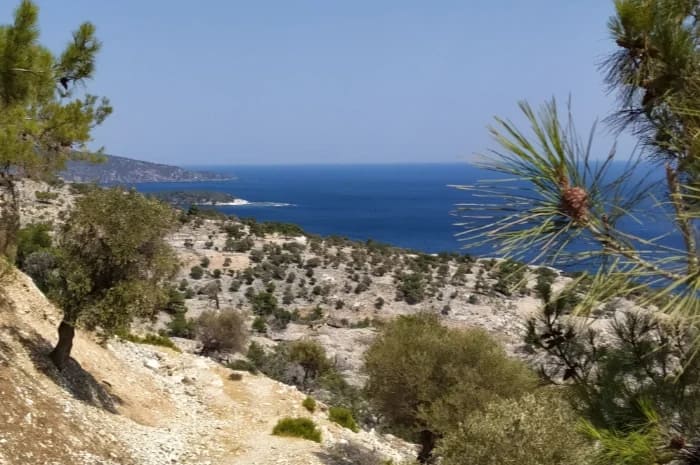
White and gray marble make up the majority of Thassos’ southern region. The small, brilliant white patch near the center of the picture is exposed white marble. Buildings made of white marble could be seen from great distances.
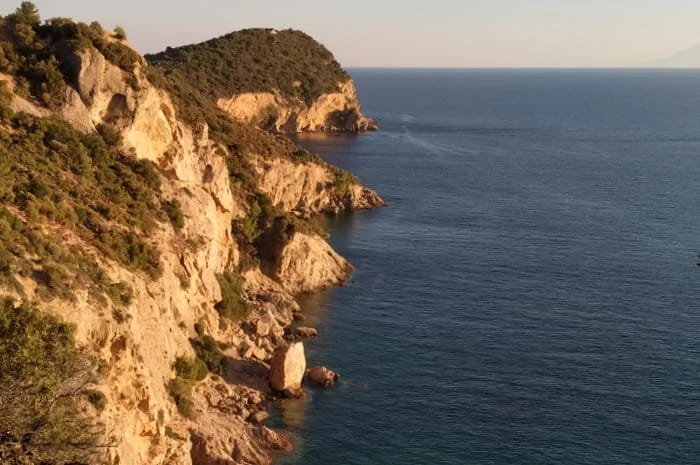
The southwest portion of the island is home to large sedimentary formations like these coastal hills, which, near sunset, have a distinctive tan color. Cliffs and caves are common in these formations. Athos mountain in the distance.
Thassos was once part of the mainland and was united with the peninsula where Keramoti town is situated. But at the end of the last ice age, due to the melting of ice and the rise of the level of the Aegean Sea, Thassos was gradually cut off from the mainland and became an island. Geologically, it belongs to the schist mass of the Rhodope Mountains.
However, in some areas in the south-southwest, there’s a limited presence of another land mass, the Serbo-Macedonian mass, which is pushed onto the Rhodope mass. This tectonic phenomenon occurs primarily in three coastal areas that are, fortunately, accessible to beachgoers.

The bare, rocky patch is part of the Servo-Macedonian land mass, set on top of the Rodope land mass, near Pefkari.

The Servo-Macedonian land mass patch, from up close. The left photo was taken from the top of the small hill.

The Servo-Macedonian land mass is in the foreground in this photo of the amazing and secluded Fari Beach in southwest Thassos.

The third and easternmost appearance of the Servo-Macedonian land mass is found at Salonikios Beach, near Potos town.
In the same part of Thassos, sedimentary rocks such as cobblestone and sandstones are locally common, and the variety of their color and texture makes these places and the beaches particularly interesting and beautiful.

Colorful rocks adorn the beaches at Astris.

Sedimentary formations near Pefkari Beach.
Thassos geology facts
Thassos is not a volcanic island.
It consists of metamorphic and sedimentary rocks, mostly marble, gneiss, and schists.
High relief at the northeast (1205m peak), lower and flatter at the southwest
It harbors gold, silver, copper, lead, zinc, haematite, and limonite.
It is famous for its amazing white marble, used in art, and the construction of many famous ancient monuments and buildings.
In antiquity, Thassos had very rich gold mines in the Kinira hilly area and under the acropolis of Limenas Town.
Herodotus himself witnessed the gold extraction, which gave Thassos the rare ability to mint gold coins—a sign of economic strength.
The Aliki ancient marble quarry is the most impressive, readily accessible geological site.
The southern part is especially dotted with abandoned metal mines and ancient marble quarries.
The headquarters of the most famous mining company is the famous landmark of Limenaria town, “Palataki,” or “Little Palace” in Greek.
Geologically quiet, it belongs to the A seismic zone of very low danger.
The coast of Thassos
What is presently near the shore was somewhat inland as the Aegean sea around Thassos rose and created a new shoreline. Thassos is blessed with an extremely varied shoreline as a result of its rich and varied geology. Discovering the coast of Thassos is a highly enjoyable experience because there seems to be an infinite amount of diversity available to the curious traveler.

Huge marble boulders create a majestic scene at the amazing Aliki, the historic marble epicenter of Thassos.

Caves are not uncommon along the rocky coast of Thassos Island. This one, near Limenaria Harbor, is easily accessible.

The impressive bare, relatively flat, rocky coast west of Giola Lagoon.

A similar, gently sloping exposed area of bare rock is close to Aliki.

Fine white sand dunes at the “Chrysi Ammoudia” Beach, near Potamia village.

An impressive beach with car-sized boulders, near Maries village.

Rough, porous, light-colored rocky coast near Notos Beach.

Steep marble coastline, typical of the Archangellos monastery area.
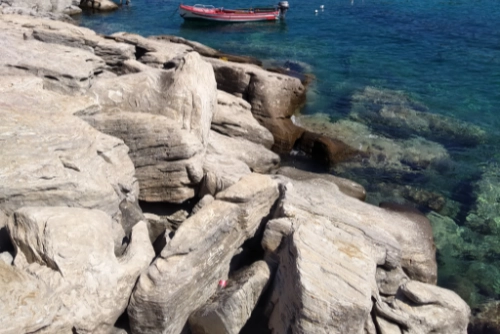
Big, rounded limestone boulders, sculpted by the constant motion of the sea, line this impressive coast.

Beach rock (a kind of sedimentary rock formed inside the sea and along the coast) sometimes lines the shores of Thassos.

Rocky shore, with vibrant calcite formations immediately adjacent to the sandy and popular Golden Beach.

The variety of colors, textures, and forms can be impressive, as in this case, near Notos Beach.

Sand, pebbles, and boulders of all shapes and sizes are frequently mixed on Thassos’ beaches.

The persistent erosion of the emerald sea created a naturally occurring, multicolored bridge.
The composition of beaches
Apart from sand, white marble is found in the form of pebbles or cobblestones on many popular beaches. Nevertheless, due to their decorative value, tourists and locals have removed many of the more appealing ones. A unique beach is “Marble Beach,” which is well-known for its marble “sand” and emerald waters. Here, the marble pebbles are particularly small, a few mm thick, whereas on other beaches, they are bigger, often a few inches across. Except for the unique instance of the marble beach, Thassos’ beaches feature a wide diversity and mixture of rocks and sand.

A field of cobblestones at Pefkari, some of them white marble.

A tranquil flat cobblestone shore at west Thassos.

Smooth, rounded marble particles make up this unique beach at Porto Vathi.

Some parts of the long and mostly narrow Kynira coast are covered with pebbles.

On other shores, stones are a minority among the dominant sand.

Or nonexistent, as on this exceptionally pure, fine-sand beach.

The sand on the beaches is variable and can even be black.

Almost equally uncommon is finding fine brown sand.

Beige-colored sand is more typical.

Fine white sand at Chrysi Amoudia
Marble mining and the marble of Thassos
Nevertheless, the island is so special and blessed geologically because a significant portion of it is made of fine marble. Specifically, crystalline calcitic white marble! Nearly 25 centuries after the start of exploitation, its exceptional quality and white color make it extremely valuable and sought-after globally. Aliki is the most significant and well-known extraction location.
Thassos marble is one of the priciest marbles, particularly the A-grade kind, which is very pure and vivid white. Due to the extreme pressure under which it formed, it is especially dense and durable. The exorbitant price is partly because it is produced in small quantities. In short, Thassos marble is white, dense, durable, rare, and expensive.

Whether using ancient or modern methods, the raw product is beautiful white marble.

The final product is often a piece of art like this still-unfinished statue at Limenaria.
The Thassos white marble comes from deposits that can reach a thickness of 300 meters. Thassian marble also has the added benefit of being the principal host of rich occurrences of valuable metals like lead, iron, zinc, and manganese, which were actively mined as recently as the 1950s.
We believe ourselves poor and vulgar if our swimming pools are not coated with Thassian marble. – Seneca
The Greeks and later the Romans valued the crystalline white marble of Thassos very highly for its exceptional aesthetic qualities. So much so that Plutarch, Pliny, Vitruvius, and Seneca all mentioned the marble of Thassos. It was used and much sought-after in Rome. Seneca went so far as to say, “We believe ourselves poor and vulgar if our swimming pools are not coated with Thassian marble.”The magnificent Greek city of Ephesus and the mausoleum of Alicarnassus, one of the seven wonders of the world, are two notable examples of its utilization.

Dense pine forests cover entire hills made of white marble near Potamia village.

This modern marble quarry is near the Porto Vathi beach, east Thassos. The road leads to the beautiful beach.

Numerous hills are mined for white marble in the north-west part of Thassos.

The remains of 1500 years of marble extraction at Aliki.

The most easily accessible sections of the hill that also had the right fractures were worked on and removed first. Wedges, hummers, and pulleys were used in the extraction.

The famous ancient marble quarry at Aliki looks uncannily similar to the modern ones, as although the tools differed, the marble was extracted in roughly rectangular shapes.

It’s easy to explore and enjoy most of the ancient quarry area on foot.

The coastal marble formations have been mined since prehistoric times.
Mining and mines of Thassos
Besides marble exploitation, Thassos has seen intense mineral mining activity. There are deserted open mines in a few easily accessible locations, such as close to Sotiras, Marries, and Limenaria towns. The biggest iron mine in the Aegean, the defunct “Mavrolakkas” mine, is a sprawling surface mine between Limenaria and Castro village.
However, the most famous mine may be the big “Vouves” mine due to its association with the “Spiedel” mining company. It was the biggest mine of “calamine,” which is a name for zinc sulfides, and is just outside Limenaria, about 1km to the left of the main road to Pefkari. From here, a century ago, lead-zinc ore was transferred to the defunct processing facility of the old, dating to 1905, German “Spiedel” mining company, located in Limenaria town. A popular tourist destination, the industrial complex stretches to the sea, where a beach and cafe known as “Metalia” are located.

An ancient crude mining tunnel built for the extraction of yellow ochre

In Limenaria town, the old “Spiedel” mining company’s offices are a famous landmark.
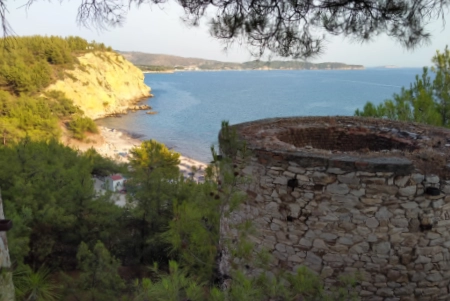
Part of the derelict industrial complex of the “Spidel” mining company overlooking the “Metalia” beach.

The processing facilities are in good condition, open to the public, and a very popular tourist attraction.

Several buildings are scattered in the area, and the beach is a popular destination.

A relic from the past serves as decor at the “Metalia” beach.

Using this ramp, the processed ore was loaded into ships.

You can easily explore the entire area on foot, which makes it an essential place to visit.

Dark brown metal oxides blanket most of the grounds.

Now, a popular cafe is situated amid the old mining company infrastructure by the beach.
