Introduction
Beautiful Thassos Island is famous not only for its emerald waters but also for the richness and diversity of its amazing nature. The beauty of the sea and land combine to create often stunning canvases, ready to be painted with colors of delight and joy. By Aegean island standards, due to its size, height, and the fact that until recent geologic times, it was part of the mainland, Thassos is a very forested island featuring a great variety of often stunning coastal and inland habitats. Surprisingly, the island’s flora, and especially its fauna, have not been studied exhaustively. New species are waiting to be discovered. Exploration and discovery in Thassos are ongoing processes!
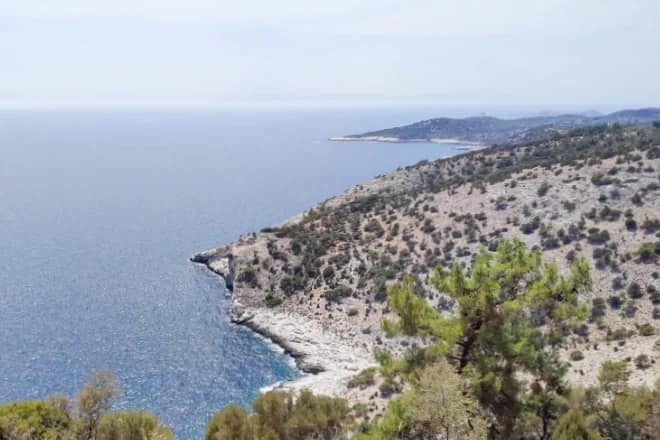
The south part of Thassos is very dry and more open, making it easier to explore on foot.
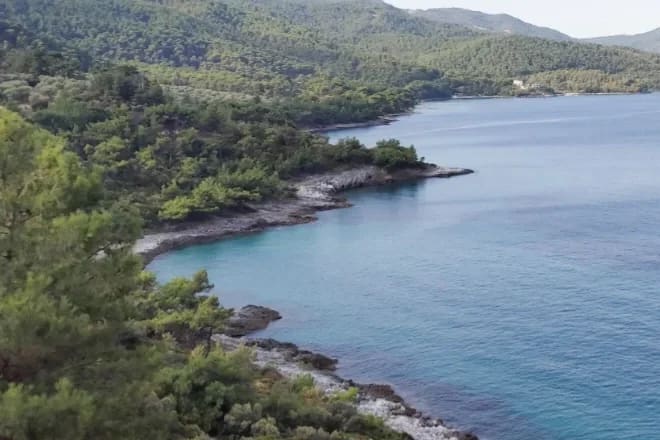
The north part is higher, steeper, wetter, cooler, and often heavily forested with mixed forests.
Thassos can be roughly divided into two parts. The steeper, wetter, densely covered northeast and the drier, flatter, sparsely covered southwest. Impressive, dense, lush forests dominated by pine trees adorn the north, while the drier south is more sparsely covered with shorter, often aromatic maquis or garigue-phrygana vegetation and innumerable old, gnarled, picturesque olive trees.

A very rare find, this huge mature clump of the protected sea daffodil pancratium maritimum, flowering in the scorching heat of summer, is a testament to the beauty of the sandy beaches of Thassos in times past. The surviving specimens of this size are extremely few.

The extensive, mature olive groves found in many parts of the island serve as a habitat for various animal species, while the cavities that are usually present in the boles of the majority of the trees serve as a refuge for the local fauna.
Thassos features habitats ranging from rocky shores where peregrine falcons patrol the coastline and the odd, rare monk seal can find refuge in a secluded cave to mountain pastures, wildflower-doted high altitude screes, surprisingly, even fir forests, and seemingly everything in between. This collage of habitats hosts a variety of common and rare species, some of which are found nowhere else. In fact, Thassos has several endemic plants, that is, plants found nowhere else in the world.
In all these habitats, excluding the first, the most notable wild animal species due to its size, color, voice, and numbers is the raven, Corvus corax.

A beautiful, very rare, pure hare’s tail grass grassland, near the beach in south Thassos.

Freshwater fish enjoy the shade of plane and alder trees in the summer heat.
Natural habitats of Thassos Island
In general terms, the natural habitats of Thassos can be categorized into a handful of types.
- Coastal habitats, where the most impressive flower is the large, fragrant, pure white bell of the protected sea daffodil, Pancratium maritimum, and marine birds are dominant. Notable common species in those habitats are: Eryngium maritimum, Crithmum maritimum, Vitex agnus-castus, etc.
- Lowland scrub, a favorite habitat of Sylvia warblers and wheatears, rich in reptile and invertebrate diversity, where the dominant small shrubs are probably the beautiful, oily, aromatic rock roses Cistus sp. Other common species are: Juniperus phoenicea, Juniperus oxycedrus, Pistacia lentiscus, Pistacia terebinthus, Erica arborea, Asparagus acutifolius, Arbutus adrachne, Arbutus unedo, Myrtus communis, Quercus coccifera, Anthylis hermanniae, Ephedra arborea, Phillirea latifolia, Spartium junceum, Paliurus spina-cristi, Cercis siliquastrum, Olea europaea etc.
- Broadleaved forests, where the most impressive members of that rare plant community are ancient, majestic plane and sweet chestnut trees. Other notable species include Fraxinus ornus, Alnus glutinosa, Quercus sp., Celtis australis, Ulmus sp., Pyrus amygdaliformis, Salix sp., etc.
- Finally, mixed coniferous forests where the dominant plant species are the island’s two species of pine and, very locally in higher elevations and wetter sites, the Aegean rarities, the Yew,Taxus baccata and the King Boris’s Fir, Abies borisii regis.

A very easily accessible and rare example of coastal pine and Kermes oak forest on a narrow sandy plain with many fine, huge specimens of Pinus brutia, is found at Prinos town’s popular “alsyllio” beach.

The tile roofs of houses, such as this in Maries village, are a favorite habitat of the black redstart, geckos, bats, and, surprisingly enough, of the great climbers of Thassos, the feral goats, like the one at the very top left corner.

Wild, steep, inaccessible rocky shores, sea cliffs, and caves are a favorite habitat for the rare peregrine falcons, sea birds, the odd monk seal, and choughs.

Coastal maquis consisting primarily of Pinus brutia, Olea, Phillirea, Cistus, Anthyllis, Juniperus, Arbutus, Myrtus, Vitex, Quercus, and Pistacia, near Saint Jonh Bay.

An especially diverse and tall maquis vegetation, comprising three species of conifers, two strawberry tree species, two heath species, and two Pistacia species, can be found in some parts of the island.

In the dryer south, mixed low phrygana composed primarily of the similar-looking lavender-leaved anthyllis, Anthyllis hermanniae, and rock rose, Cistus, can be found.
In these natural habitats, the most noticeable plants, due to their numbers, size, shape, color, or flowers, will tend to be the following:
Common plants of Thassos
| Plant | Notes |
|---|---|
| Thassos lowland pine, “Pinus brutia” | It is the common kind of lowland pine and a primary source of honey. The pine honey of Thassos, “pefkomelo” is famous. It extends to Lebanon and north Iraq. |
| Olive tree, “Olea europea” | Common, especially in the drier south. I can be tiny, spiny, and bonsai-like when growing on tiny rock crevices by the sea. |
| Rock rose, two species, “Cistus sp” | It is very common in dry, open lowlands and enriches the air on the island with a characteristic aroma. It is very oily and a primary bee plant. |
| Lavender-leaved Anthyllis, “Anthyllis hermanniae” | Yellow-flowered sub-shrub, especially common in rocky, sunny, dry locations. When dried, it can be made into a nice, hand-made broom. Another bee plant. |
| Rock Samphire, “Crithmum maritimum” | It is very common on rocky beaches and keeps flowering in the heat of summer. Can be tiny when growing in rock crevices or huge in favorable conditions. |
| Phoenician Juniper ” Juniperus phoenicea” | Soft-leaved, loves dry, rocky, sunny areas with fine examples on the road to Archangellos monastery. |
| Plane tree “Platanus orientalis” | No two trees are alike, and ancient ones are awe-inspiring. Unmistakable. |
| Heath “Erica sp” | Two species of heath are very common elements of the vegetation, from practically sea-level to high in the mountains. |
| Mastic tree, “Pistachia lentiscus” | Very common, even in saline conditions. Commonly found on sandy beaches, scrub, and under pines. Aromatic, evergreen small tree, usually a bush, with ivory-colored resin that is sold all over the world. |
| Chaste tree, “Vitex-agnus-castus” | Common even on sandy or rocky beaches, with leaves that look quite similar to the leaves of the cannabis plant and flowers ranging from white to deep blue. |
| Judas tree, Redbud, “Cercis siliquastrum” | Unmistakable in flower and leaf, widely distributed. Unfortunately, it flowers very early. |
| Kermes oak, “Quercus coccifera “ | It is very common on the mainland and in Thassos. It can be a big tree, but it is usually a bush with hard, shiny, spiny leaves. |
| Holm oak, ” Quercus aria” | Large evergreen oak with soft, shiny leaves and dense foliage. It avoids the driest places, and hence, it is more common in the north. |
| Dragon lily, “Dracunculus vulgaris” | A poisonous, stunning aroid during its ephemeral flowering in spring. It is the largest and most impressive European flower and grows scattered among scrub. |
| Cyprus strawberry tree, “Arbutus andrachne” | A jewel of a plant, this evergreen heath relative is unmistakable for its smooth, colorful peeling bark and red fruits in autumn. Avoids the driest places. |
| Black pine, ” Pinus nigra pallasiana” | Beautiful, straight, small-cone pine avoiding the lowlands. Usually, it does not descend lower than 400m. |
| Common or True Myrtle, “Myrtus communis” | Evergreen, aromatic, shiny, pointed, soft leaves, white flowers, and blue-black small berries. Usually 3-6 feet tall. |
| Sweet chestnut, “Castanea sativa” | Rare in the south but common in the north, where it grows to huge size, and amazingly, contrary to the mainland, where it avoids low altitudes, it even descends to practically sea level. |
| Tamarisk or salt cedar, “Tamarix sp” | A very salt-torelant native small tree, often used as an ornamental shade tree close to the shore. |
| Mint | A splendid sub-shrub in flower, with a heavenly mint aroma, it is locally very common in rocky, sunny, dry places and grows even on sandy beaches. Anything wider than 3 feet is considered huge. |

Flowering early in spring, before the leaves appear, the redbud or Judas tree is common everywhere but larger in the north.

The plane, a native mostly of Greece, grows into a very picturesque tree with age. Each tree is a unique sculpture of nature.

A rare pure stand of large spiny broom, Calicotome villosa, leguminous shrubs, near Kazaviti village.

The aromatic mastic tree, a relative of the cashew nut tree, is a very common shrub, rarely growing to a small tree.

The lowland pine of Thassos, Pinus brutia, is remarkable for the variability of its bark color, ranging from light gray to pitch black.

The beautiful, delicate-looking Tamarisk tree, spreads its lovely fragrance far and wide and can flower anytime.

The Phoenician juniper, Juniperus phoenicea, is a beautiful, soft-leaved, bushy conifer common in the dry lowlands and a primary constituent of maquis vegetation.

The evergreen Rock Samphire, Crithmum maritimum, is common all around the coastline and can grow several meters wide like this huge specimen.

The tiny flowers of the amazing mint can have a variety of colors but are usually white or violet.

The evergreen holm oak, Quercus aria, is a beautiful glossy-leaved tree that prefers wetter places, so it is less common in the south.

The wild olive tree, Olea europea, is widespread and a real chameleon of a plant. It can range from a tiny bonsai-like, very thorny, tiny-leaved bush, such as this specimen, on dry, stony ground to a big ancient tree. To its right is a lavender-leaved anthylis.

The most beautiful native tree of Europe, although usually a bush, the Cyprus strawberry tree, apart from its beautiful, glossy, evergreen foliage, showy white flowers, and red fruits, has the added merit of an amazing, smooth, peeling multicolored bark.

The wild olive tree, Olea europea, is widespread and a real chameleon of a plant. It can range from

The most beautiful native tree of Europe, although usually a bush, the Cyprus strawberry tree, apart f
A variety of animals live in these habitats, ranging from the often-seen, omnipresent raven and common swift to the rare and elusive peregrine falcon and blue rock thrush. Incidentally, the Metalia area of Limenaria is a nice place to spot the latter bird. The main birds you are most likely to encounter and catch your attention in Thassos are mostly common European ones:
Common birds of Thassos Island
| Bird | Notes |
|---|---|
| Sea-gull. Various species. | They are the first birds you meet (or feed!) when you visit Thassos. |
| Raven, “Corvus corax.” | It is very common everywhere. |
| Collared dove, “Streptopelia decaocto.” | It prefers human habitations; it is a common garden bird that nests anywhere, even on a cactus pot on my balcony. Although it is a seedeater, it can be seen enjoying cat food pellets on the ground. |
| House sparrow and tree sparrow. | For some reason, they are not as common as on the mainland. |
| Blue tit, “Parus caeruleus.” | Unlike Sylvia warblers, it is unmistakable among the foliage of garden trees. |
| Various species of warblers “Sylvia sp.” | Very common near human habitations, regular visitors of gardens, not very easy to tell apart. |
| Swift, “Apus apus.” | One of the first birds to wake up and last to go to sleep, flying even after sunset. |
| Swallows, “Hirundo” and “Delichon” sp. | The red-rumped swallow and the common swallow,are the most common and noticeable hirundines. Usually, they arrive the last week of February or the first week of March. |
| Bee-eater, “Merops apiaster.” | Not very common, but unmistakable in voice and color. Gorgeous, gregarious, and noisy, often flying low and slow. Thassos is littered with thousands of beehives, offering a rich food source. |
| Goldfinch, “Carduelis carduelis.” | Gregarious, splendid seedeater, near thistles and other thorny annuals, often on sunflowers in gardens. |
| Spotted flycatcher, “Muscicapa striata.” | A common village bird, often nesting in holes or on the ledges of houses, although grey-brown and drab in appearance. |
Wild mammals of Thassos Island
Mammals are not as well represented as birds, but they still constitute an important and often very notable part of the fauna. Although up to about 10.000 years ago large mammals like antelopes (Saiga tatarica), buffalos, and European wild donkeys roamed the island, now the biggest wild land mammals are the many hares (Lepus europaeus) and martens (Martes foina). Martens, at times, can be very common locally, as was the case in Limenaria a few years ago. Martens were almost as common as cats and were frequently confused with them. You could even see the bolder ones walking among people who were enjoying their coffee at the beach cafés, climbing onto cars, as if confident that most people would think they were cats! And many did.

Despite thousands of years of hunting, hares still survive on the island. Thassos Archaeological Museum.

A variety of dolphin species and other cetaceans frequent the waters of Thassos. Thassos Archaeological Museum.
But while only small wild mammals roam the land, it’s a different story with the coast and sea around Thassos. The Mediterranean monk seal, a large species that can surpass 10 feet in length, is sometimes spotted on the shores, and the waters surrounding the island hide cetaceans ranging in size from the rare, shy, and tiny dolphin-like 4-foot porpoise “Phocoena phocoena” to the huge sperm whale “Physeter macrocephalus,” the largest toothed predator, which is resident and breeds in parts of the Aegean Sea. Other species include the elusive Cuvier’s beaked whale; the striped dolphin, Stenella coeruleoalba, which is the most common in the area; the Risso’s dolphin, Grampus griseus, which is a large migratory dolphin with a whitish back and black fin tips; the common bottlenose dolphin, Tursiops truncatus, one of the most common species; and the common dolphin, Delphinus delphis, which, contrary to its name, is very rare.
What may be even more remarkable is the presence on the island of the exceedingly rare and globally threatened Mediterranean monk seal, Monachus monachus. While most seal species prefer cold, northern climates, luckily for us, a few, like the California sea lion, the Hawaiian, and the Mediterranean monk seals, have adapted to far warmer waters. What makes its presence even more precious is that it is the rarest seal species in the world. In fact, of the approximately 800 surviving individuals, half live in Greek waters.
Known and revered since ancient times for their perceived connection with Poseidon and Apollo, they were present in far greater numbers in the past. They have been mentioned by a plethora of ancient writers, like Homer and Aristotle (he was the father of zoology after all), depicted on coins and art, and even gave their name to an ancient Greek city, Fockaea, in Asia Minor. Unfortunately, centuries of persecution for their meat, fur, and oil, led to their drastically smaller numbers.
The monk seal is a large animal that can grow about 10 feet long and 300 kg! On the other hand, newborns are approximately 3 feet long, have a soft, wooly, black protective layer, and weigh around 16 kg. With luck, they can live up to 30 years in the wild. A single pup is born on land between August and December, but the peak of births coincides with mid-October. Lactation and nursing can take up to 5 months, and during that time, mothers often leave their pups unattended in a cave while searching for food. The preferred kind of cave is well-protected, remote, and inaccessible and is used mainly at night and in the winter. Every year, there are sightings of monk seals on Thassos, giving the island a special attraction.
Fish, squid, and octopus are the favorite prey of these sea mammals, and along with a great variety of marine life, they are abundant in the deep blue waters of the Aegean Sea encircling Thassos. I remember a particular evening sitting at Limenaria Harbour, leisurely eating sunflower seeds and watching the sea urchins just before my feet. In the span of half an hour, to my surprise, a two-foot-long eel, an octopus, and a cuttlefish slowly passed by. Not to mention the huge European spider crabs lurking perfectly camouflaged at the bottom, ready to eat anything edible that fell into the water. In this case, it was part of the white of an egg. That made me wonder about the richness of sea life around Thassos.
Reptiles of Thassos Island
Greece has the greatest variety of reptile species in Europe, and this is reflected in the number of species found in Thassos. You can find the big, the strange, the rare, the dangerous, and the mundane. Let’s make it clear, though, that if you are suffering from reptile phobia, there is good news! Although the variety of snakes is great, their numbers are not. Having spent many months on the island over the years, I never chanced upon a live snake, and I rarely saw lizards. The numbers on the mainland, however, are decidedly larger. Such a low frequency of sightings would be unheard of. I firmly believe Thassos is a pretty boring place for herpetologists!

Thassos have several snake species that can grow to about 6 feet long, but the only dangerous one, the nose-horned viper, is half that size.

A Thassos rarity, the Balcan wall lizard, Podacris taurica, is decidedly more common on the mainland.

The European glass lizard is a large, legless lizard found from southern Europe to central Asia. The young have this distinctive gray-black pattern.

The only dangerous snake on Thassos is the readily distinguished nose-horned viper, Vipera amodytes, which, like this one, in the summer can be active at night.
That being said, Thassos has 10 species of snakes, two species of tortoises, and two species of terrapins. While there are big snakes in Thassos, like the four-lined and the Montpellier snake, that can reach 6 feet in length, the only very dangerous snake is the much smaller nose-horned viper, Vipera ammodytes, which is usually less than 3 feet (1m) long. Luckily, it’s a very distinctive and easily identifiable snake. It can be easily distinguished in the field by its plump, rough body, triangular head, and dark zig-zag pattern on its back. On the other hand, sometimes it can blend very well with its surroundings and often lies still in the middle of a path, seemingly confident in its ability to blend in.

The Greek tortoise, Testudo graeca, is one of the three species of Greek land tortoises and the only one living in Thassos. It can grow to a foot long, lay up to a dozen eggs, and reach a lifespan of approximately a century.

The Kotschy’s gecko, Mediodactylus kotschyi, is a small, often home-dwelling lizard growing to about 4 inches, not equipped with adhesive pads, and can blend with dark backgrounds.
Apart from snakes, in Thassos lives the largest European lizard, the glass lizard, Pseudopus apodus, which can grow to over 3 feet long. However, it looks like a snake, on account of the almost complete absence of limps, and moves like one. It is completely harmless.
Insects and invertebrates of Thassos Island
As you probably have guessed, Thassos is rich in insect life and related invertebrate species. This is the most underexplored sector of the wildlife of Thassos and Greece in general. The biodiversity is understandably great, and there are a small number of species that can be dangerous. Primarily, some spiders and centipedes. Thankfully, the very poisonous and potentially very dangerous scorpion of the mainland, the yellowish Mesobuthus gibbosus, with slim pincers, is absent from the island. Instead, the widespread scorpion on the island is E. scaber. A small, dark brown, quite harmless scorpion! It can be found on the ground and even quite high up under the bark of old or sick trees.
On the other hand, there are a few native spider species that can be dangerous. Two notable examples are the Mediterranean recluse spider, Loxosceles rufescens, which is often associated with human habitations, and Latrodectus tredecimguttatus, the Mediterranean black widow, which fortunately does not live in close association with humans.

The Mediterranean recluse spider, Loxosceles rufescens, is often associated with human habitations and found inside houses, like this one in south Thassos.

The stunning oleander hawkmoth, Daphnis nerii, is a tropical and subtropical moth and a summer visitor from Africa. Its large larva feeds on oleander.
The Mediterranean recluse spider prefers very dark and secluded spaces, like caves and the basements of old houses. They are nocturnal and, being small-bodied, hunt silverfish and other tiny arthropods. They are not passive predators that rely on a web but instead, actively hunt their prey. Its bite can be dangerous and, in some individuals, can cause significant damage. They typically live up to three years and interestingly, they have proven very invasive as they have spread to many parts of the globe, including parts of the USA. Its range extends to central Asia, and it likes warm weather. Its body grows to about 7 mm in length
Another dangerous spider is the Mediterranean or European black widow, Latrodectes tredecimguttatus. Typically black, with thirteen usually red or yellow spots on the upper part of the abdomen, it prefers open, dry, steppelike lands. The female has a body length of about 7–15 mm, while the male is half that much. Fortunately, only the female’s bite is potentially dangerous, as the male is too small to penetrate the human skin.

Thassos is a paradise for bees, hosting a huge number of colonies. In late spring, thousands of colonies swarm and leave the beehive, seeking to create new colonies at suitable locations, often on the branches of trees.

An impressive big moth, the death’s head hawkmoth, Acherontia atropos, named for the skull-like marking on its thorax, often enters beehives to get at the honey. It is a summer visitor from Africa.
However, although these creatures can bite or sting, they are not found everywhere or in great numbers. You are far more likely to get stung by the omnipresent bees, which are especially common on the island. This is due to the enormous number of beehives that exist on Thassos Island. Thassos is famous not only for the quality of its honey but also for the number of beehives and honey production relative to the population and surface area of the land. Using those metrics, it ranks number one in the world. This is understandable since practically all the common flowering plants of Thassos are wonderful bee plants. And of the non-flowering ones, the innumerable pines of the island contribute to the creation of the wonderful “pefcomelo,” or pine honey, which has the characteristic of not solidifying as the flower-derived honey does.

Thassos is underexplored in many ways, and new invertebrate species are discovered regularly. However, species such as this admiral butterfly of Potamia can hardly escape detection.

The stunning oleander hawkmoth, Daphnis nerii, is a large tropical and subtropical moth. It is a summer visitor from Africa, and its large larva feeds on oleander.
Now let’s dive into some interesting facts about the nature of Thassos Island.
Thassos nature facts
One of the most forested islands in the Aegean Sea.
It even has small forests of fir and yew
Very rich flora..species of plants
…endemic species
Griffon vultures lived in the recent past
One species of plant is considered extinct.
The largest mammal is the very rare monk seal. (several sightings every year).
Saiga Antelope and Buffalo lived on the island up to 10.000 years ago.
The largest wild land carnivore is the marten.
A very large number of bee hives
The most impressive and biggest flower (up to 2 feet long), is the flower of the dragon lily.
The most dangerous land animal is the nose-horned viper.
The local common scorpion is harmless
A large number of goats roam free on the island.
reptile species
The smallest cetacean is the Porpoise (4 feet), and the largest is the sperm whale.
a lot of trails and organised activities to explore the island
Still relatively unexplored.
Thassos island fauna
Explore the world of the wild animals of Thassos
Thassos Island Flora

Explore the flora and botany of Thassos.
